
21 October 2026 · 5 min read
Refrigerant changes and what they mean for cool room owners
Australia is cutting back on HFC refrigerants. Here is what the rules say, what they don't, and what it means when your cool room needs gas.
By Mick McDonald, SPA Refrigeration
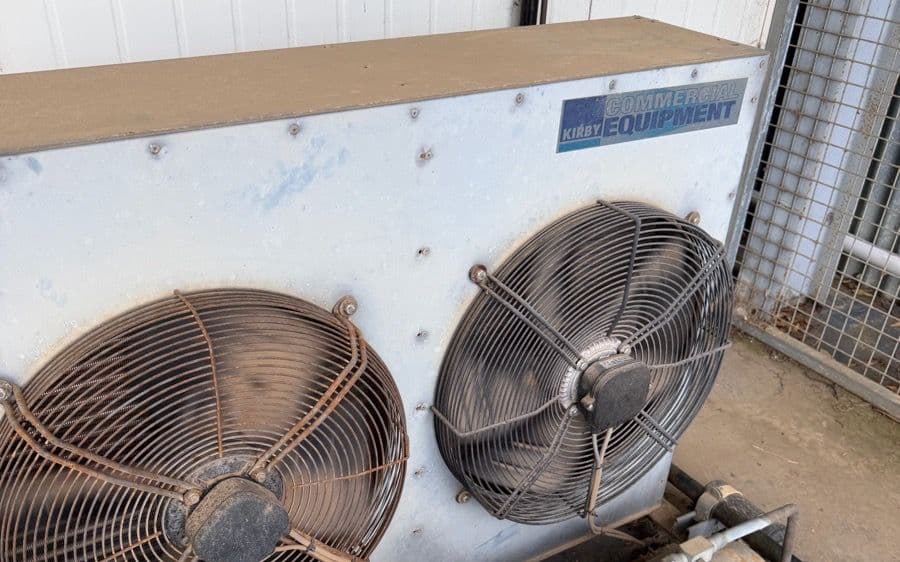
Somewhere on your cool room's condensing unit there is a compliance plate. On a lot of older cool rooms in the district it will say R404A. It is one of the refrigerants Australia is steadily cutting back on, and owners hear all sorts about it.
This is the plain version, taken from what the federal government actually says. At the time of writing, those pages sit with the Department of Climate Change, Energy, the Environment and Water (DCCEEW). The department notes that the new National Environmental Protection Agency was set up on 1 July 2026 and the content is moving across to it, so if you go looking you may find it under either name.
What is being cut back
Most refrigerants in cool rooms, fridges and air conditioners are hydrofluorocarbons, or HFCs. They don't damage the ozone layer the way older gases did, but they are strong greenhouse gases. DCCEEW lists the global warming potential of R404A at 3,922. That means a kilogram of it in the atmosphere traps about as much heat as 3,922 kilograms of carbon dioxide.
Australia's HFC phase-down started on 1 January 2018. It is a gradual reduction in how much HFC is allowed into the country through an import quota, and the amount comes down to 15% of the baseline level by 1 January 2036. It is a phase-down, not a phase-out. A smaller amount keeps coming in after 2036, and DCCEEW says it expects that to be used partly for servicing equipment already in Australia.
The rules sit under the Ozone Protection and Synthetic Greenhouse Gas Management Act 1989 and its regulations.
What it does not mean
This is the part that gets lost. According to DCCEEW:
- the phase-down covers imports of bulk gas, such as cylinders, not gas that arrives already inside new equipment
- existing equipment already in Australia is not affected
- equipment owners do not have to replace existing equipment because of it
- technicians can still buy HFCs to maintain equipment, and recovered gas can be reprocessed to add to supply
So nobody is coming to switch off your cool room, and you are not breaking a rule by running an R404A system.
What could change
DCCEEW is open about the fact that more is being looked at. It says bans on importing or manufacturing new equipment may be considered in future where alternatives are readily available, only after a review and consultation with industry, and that any such ban would apply to new equipment, not to equipment already installed. HFCs are also on the Industrial Chemicals Environmental Management Standard workplan for 2026 to 2027, and the department says possible measures include limits on what certain HFCs can be used for, which may take in pre-charged equipment.
None of that is decided. If you are planning a new cool room, ask which gas it will run on and why.
The rule that matters when your cool room needs gas
Since 1 January 2020 there has been a charging rule that affects every cool room owner directly. Equipment cannot be charged with a refrigerant of higher global warming potential than the one it was designed for. Charging with a lower one is allowed, and DCCEEW gives the example of replacing R404A with R452A, which it lists at 2,139.
That does not mean any system can be swapped to any gas. DCCEEW says a system should not be charged with a refrigerant with a higher hazard rating, such as a flammable one, unless it has been converted under the relevant codes of practice and standards, and that a change of gas needs full recovery of the old refrigerant and a leak test. Manufacturer guidance matters here too.
Why a leak is the real question
When a cool room is short of gas, the gas went somewhere. DCCEEW's own guidance to technicians is to fix leaks before recharging a system, and it is illegal to release regulated refrigerants into the air. On a service call we look for the leak first, because topping up a leaking system only buys time.
Once we know what is wrong, the choice is usually one of three:
- Find and fix the leak, then recharge with the design refrigerant.
- Where the system and the manufacturer allow it, change to a lower warming gas while the system is open anyway.
- If the system is old, leaking in several places or has other faults, talk about replacing it.
Repairs are charged as a service call: the call-out, the time on site and any parts. A replacement is a different job. We measure up and quote it before anything is ordered, and we will tell you which gas the new equipment uses. DCCEEW lists ammonia, carbon dioxide, hydrocarbons and hydrofluoro-olefins as low or zero warming alternatives already available in Australia.
Who is allowed to touch it
Handling these refrigerants needs a Refrigerant Handling Licence, and DCCEEW says it is an offence for anyone else to handle them. Businesses that buy and hold refrigerant need a Refrigerant Trading Authorisation. Both are run by the Australian Refrigeration Council, the ARCtick scheme, and the ARC has an authorised business search where you can check anyone working on your gear. We hold an ARCtick licence, do our own licensed electrical work and are fully insured.
If your cool room is low on gas or getting on in years, contact us or ring 0417 734 206 and we will book a visit to look at it properly. You can read more about our refrigeration work or how a cool room that ices up can point to a gas problem.
Mick McDonaldSPA Refrigeration & Air Conditioning
Want a hand with yours?
We install and service heating, cooling and refrigeration across Central Victoria from our base in Hepburn.